


For homeowner and condominium associations, membership and board meetings are not routine gatherings. Membership meetings tend to be where directors are elected and governing documents amended. Boards govern the association throughout the year, exercising authority that directly affects owners’ property rights and financial obligations.
Because of that, how meetings are conducted matters, both legally and practically. In many states, and in many association governing documents, meetings are required to be conducted in accordance with the most recent edition of Robert’s Rules of Order (sometimes described as the “current” or “latest” edition). When that is the case, having the correct and current edition is not optional. It is part of sound governance and legal compliance.
Parliamentary Procedure Isn’t Optional for Community Associations
If you attend or lead business meetings, you should at least understand the basics of parliamentary procedure. State laws and association governing documents prescribe the rules organizations must follow to transact business. For many homeowner and condominium associations, those rules frequently point directly to Robert’s Rules of Order Newly Revised.
Ignoring mandatory rules, or applying them incorrectly, can lead to embarrassment, hard feelings, and even lawsuits. Improper notice, flawed voting procedures, or meetings run without required safeguards can undermine confidence in the board and expose decisions to challenge.
At the same time, the benefits of proper procedure go well beyond legal concerns. Well-run meetings are more efficient, less contentious, and easier for everyone involved.
Well-Run Meetings Benefit Boards, Managers, and Owners
Parliamentary procedure is not about formality for its own sake. When applied correctly, it helps meetings move forward in a fair and orderly way. Clear rules for debate, motions, and voting reduce confusion and keep discussions focused. They also protect minority viewpoints while allowing the majority to make decisions.
For community associations, proper procedure can turn long, confrontational meetings into shorter, more productive ones. For board members and officers, that often means fewer frustrated owners and greater confidence in board actions. For community managers, it means meetings that are easier to guide and less likely to go off track.
In Some States, Robert’s Rules Is Required by Statute
For homeowner and condominium associations, the need to have the correct and current edition of Robert’s Rules is not just a best practice. In some states, it is the law.
In North Carolina, both the Condominium Act and the Planned Community Act provide that, unless the bylaws state otherwise, meetings of the association and the executive board must be conducted in accordance with the most recent edition of Robert’s Rules of Order Newly Revised. See N.C. Gen. Stat. § 47C-3-108(c) and 47F-3-108(c).
That means for many North Carolina associations, Robert’s Rules is not simply a default guideline. It is the rule of order prescribed by statute. Using an outdated edition or a substitute book can create real risk when meeting actions are later questioned.
Other states take similar approaches, with statutes that either specifically refer to Robert’s Rules or require meetings to be conducted under a recognized system of parliamentary procedure. The details vary, but the theme is the same: meeting procedure is often a matter of law, not just preference.
Parliamentary Procedure Does Not Look the Same in Every Meeting
It often comes as a surprise that parliamentary procedure does not apply the same way to every meeting. Robert’s Rules generally recognizes that larger membership meetings tend to be more formal, while smaller bodies, such as boards and committees, can operate very informally.
In other words, the parliamentary rules are different depending on the size and nature of the group. Understanding that distinction is one reason it is important to rely on the actual rules, rather than assumptions about how meetings are “supposed” to work.
What Robert’s Rules Actually Covers
It is often assumed that Robert’s Rules is only about motions. Motions are important, but they make up only part of the book.
The current edition addresses issues that HOA and condominium leaders regularly face, including:
- How to preside at a meeting, even if you have never chaired one before
- Differences in procedure between board meetings, committee meetings, and membership meetings
- How to prepare and approve minutes (NOTE: annual meetings generally do not approve minutes)
- Rules for debate and decorum when meetings become contentious
- Handling disruptive owners or guests
- Voting requirements and election procedures
For associations that rely on Robert’s Rules of Order, the book serves as a practical reference for day to day governance, not just a technical manual.
Why It Is Easy to End Up With the Wrong Book
Despite its importance, many associations accidentally purchase the wrong book.
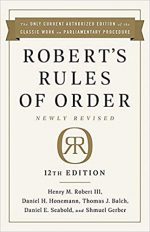
The phrase “Robert’s Rules” is not copyrighted. As a result, there are many books with similar titles, including summaries, study guides, older editions, and unofficial knockoffs. Some are helpful educational tools, but they are not the parliamentary authority required by statutes or governing documents.
There is always one official successor to earlier editions. The current authority is Robert’s Rules of Order Newly Revised (12th Edition), released in late 2020. It is more than 700 pages long, clearly marked as the Twelfth Edition, and looks like this.
If an association’s documents refer to the “latest” or “most recent” edition of Robert’s Rules, this is the book. Using an outdated edition or different book could give the wrong answer and make decisions more vulnerable to challenge.
Why Many HOA and Condo Leaders Need More Than the Full Manual
Even if you have the correct edition, many board members and community managers find it difficult to use in real time. Robert’s Rules is thorough by design, but it can be hard to navigate during an active meeting. It’s also not designed to be read cover-to-cover, but to be used as a reference.
That’s why supplemental resources can be helpful, so long as they are used in addition to, not instead of, the official manual.
A Practical Starting Point: Robert’s Rules of Order Fast Track
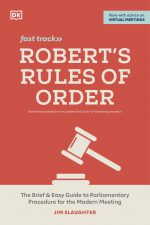
Robert’s Rules of Order Fast Track was written for people who want meetings to run smoothly without having to master every technical detail.
For HOA and condominium boards, Fast Track focuses on the rules that most often come up in real meetings, including motions, voting, agendas, minutes, and officer roles. It is written in plain language and is especially helpful for new board members and community managers who regularly advise boards but have not read all of Robert’s.
It is not a replacement for the official Robert’s Rules. Instead, it serves as a practical introduction and an everyday reference that helps apply the basics correctly.
A Deeper Resource for Complex Companion: Notes and Comments on Robert’s Rules
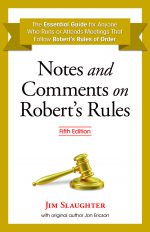
Some associations face more complicated procedural questions. This is often true for larger communities, associations with frequent owner participation, or boards dealing with contentious issues.
For those situations, Notes and Comments on Robert’s Rules is designed to be used alongside the official Robert’s Rules of Order Newly Revised. Rather than summarizing the rules, it explains why they exist and how they are intended to work in practice.
Written in a question and answer format drawn from real meetings, it focuses on provisions that are most often misunderstood, disputed, or misapplied. The Fifth Edition is fully updated to the Twelfth Edition and includes extensive discussion of electronic, virtual, and hybrid meetings, which are now common in community associations.
The Bottom Line for Community Associations
For homeowner and condominium associations, meeting procedure is not just a matter of style. In many cases, it is a legal requirement. If state law or an association’s governing documents require meetings to be conducted under Robert’s Rules of Order Newly Revised, the community manager or association should have access to the correct and current edition.
From there, the right additional resources depend on the association’s size, complexity, and meeting culture. Some boards benefit most from a concise, practical guide that helps meetings move efficiently. Others need a deeper companion to resolve procedural questions with confidence.
Either way, understanding and correctly applying parliamentary procedure helps boards and managers make better decisions, reduce conflict, and run meetings that members view as fair, orderly, and professional.
Jim Slaughter is an attorney and professional parliamentarian who regularly advises homeowner and condominium associations on meeting procedure and governance. He is the past President of CAI’s College of Community Association Lawyers, the American College of Parliamentary Lawyers, and the NC Chapter of the Community Associations Institute.
He is the author of four books on parliamentary procedure, including Robert’s Rules of Order Fast Track: The Brief and Easy Guide to Parliamentary Procedure for the Modern Meeting and Notes and Comments on Robert’s Rules, Fifth Edition, both updated for the Twelfth Edition of Robert’s Rules of Order Newly Revised.
For more information, visit www.jimslaughter.com.