


In most associations, significant decisions are made at board, committee, and membership meetings. Budgets are adopted. Directors are elected. Budgets are adopted. Directors are elected. Governing document amendments and policies are approved. When an organization says it follows Robert’s Rules of Order, it is committing to run its meetings under a recognized, structured system designed to promote fairness, order, and clear decision making.
Because of that, how meetings are conducted matters, both legally and practically. Many association governing documents require that meetings be conducted in accordance with the “current edition” of Robert’s Rules of Order. When that is the case, having the correct and current edition is not optional. It is part of sound governance and legal compliance.
Parliamentary Procedure Is More Than “Just Robert’s”
Parliamentary procedure is not simply a single book called “Robert’s Rules.” It is a broader field that includes several different parliamentary authorities. Some professional associations use The Standard Code of Parliamentary Procedure (often called Sturgis). State legislatures frequently rely on Mason’s Manual of Legislative Procedure. Those groups do not refer to Robert’s Rules at all.
That said, for nonprofit associations, unions, homeowner and condominium associations, houses of worship, and other organizations, Robert’s Rules of Order is by far the dominant parliamentary authority. It is the best known and the most widely adopted.
In fact, courts have sometimes relied on Robert’s Rules even when an organization’s governing documents were unclear. Its widespread acceptance and easy availability are part of what makes it so influential.
What Robert’s Rules Actually Covers
Many people think Robert’s Rules is only about motions, such as a motion to Adjourn or the Previous Question. Motions are important, but they make up only about a third of the current book.
The rest of Robert’s Rules addresses issues that association leaders face every day, including:
- How to preside over a meeting if you have never chaired one before
- How to prepare agendas and run meetings efficiently
- How to take proper minutes, including what should and should not be recorded
- How to handle disruptive members or guests
- How boards and committees operate differently from membership meetings
For leaders and executives who regularly deal with meetings, Robert’s Rules is not just a rulebook. It is a practical reference for running meetings that are orderly, fair, and defensible.
Why It Is Easy to Buy the Wrong Book
Here is where many organizations go wrong.
The phrase “Robert’s Rules” is not copyrighted. As a result, there are dozens of books with “Robert’s Rules” in the title. Some are summaries. Some are study guides. Some are older editions. Some are knockoffs that have little to do with parliamentary procedure at all.
Many of these books have value for education or quick reference. But they are not the official parliamentary authority your bylaws are referring to.
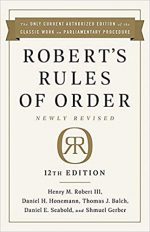
There is always one official successor to the original Robert’s Rules of Order. The current and controlling parliamentary authority is Robert’s Rules of Order Newly Revised.
The Twelfth Edition was released in late 2020. It can be identified by the words “12th Edition” on the cover and by its length. It is more than 700 pages long, and it does not contain cartoons or simplified summaries. If your governing documents refer to the “latest edition” of Robert’s Rules, this is the book they mean.
Having an outdated edition or the wrong book entirely can lead to incorrect rulings, unnecessary disputes, and decisions that are vulnerable to challenge.
Why Many Leaders Need More Than the Full Manual
Even when an organization has the correct edition of Robert’s Rules, many leaders find it difficult to use in real time. At more than 700 pages, it is thorough by design, but it is not always easy to navigate during a fast moving meeting. It’s also a reference and not designed to be read cover to cover.
That’s where supplemental resources can be valuable, depending on the reader’s role and needs.
A Practical Starting Point: Robert’s Rules of Order Fast Track
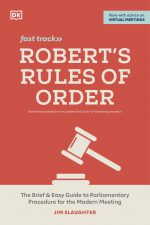
Robert’s Rules of Order Fast Track was written for people who want meetings to work, not for those who want to master every technical nuance of parliamentary law.
It’s a concise, practical guide that focuses on the rules that actually come up in everyday meetings. It explains motions, voting, agendas, minutes, and officer roles in plain language. It also addresses modern realities, including electronic, virtual, and hybrid meetings.
For board members, officers, managers, and executives who want a clear and usable introduction to parliamentary procedure, Fast Track is often the most approachable place to begin. It is not a replacement for the official Robert’s Rules. Instead, it helps leaders understand and apply the core concepts without being overwhelmed.
A Deeper Companion: Notes and Comments on Robert’s Rules
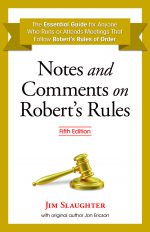
For organizations and leaders who regularly face complex procedural questions, Notes and Comments on Robert’s Rules serves a different purpose.
Notes and Comments is designed to be used alongside the official Robert’s Rules of Order Newly Revised. Rather than summarizing the rules, it explains why they exist and how they are intended to work in practice. It focuses on provisions that are most often misunderstood, disputed, or misapplied.
Written in a question-and-answer format based on real meeting experience, the book provides context, explanation, and practical guidance. The Fifth Edition is fully updated to the Twelfth Edition of Robert’s Rules and includes extensive discussion of electronic and virtual meetings.
For chairs, parliamentarians, staff, and counsel facing real procedural disputes, Notes and Comments fills the gap between the black-and-white rules and how they are applied in practice.
The Bottom Line for Association Leaders
If your organization follows Robert’s Rules of Order, the starting point is simple. You should have access to the correct and current edition of Robert’s Rules of Order Newly Revised. Without it, you are relying on something other than what your governing documents likely require.
From there, the right additional resources depend on your role. Some leaders benefit most from a concise, practical guide that helps meetings run smoothly. Others need a deeper companion that explains the reasoning behind the rules when questions or conflicts arise.
Used together, the official Robert’s Rules and the right supplemental resources can help meetings be shorter, fairer, and more effective, and help leaders make decisions with confidence that their process is sound.
Jim Slaughter is an attorney and professional parliamentarian who advises organizations across the United States on meeting procedure, governance, and the practical application of parliamentary law. He is a Certified Professional Parliamentarian, Professional Registered Parliamentarian, and past President of the American College of Parliamentary Lawyers.
Jim has served as parliamentarian to thousands of meetings, ranging from small homeowner and condominium association boards to some of the largest conventions and annual meetings in the world. His work focuses on helping organizations conduct meetings that are efficient, fair, and legally defensible.
He is the author of four books on parliamentary procedure and effective meetings, including Robert’s Rules of Order Fast Track: The Brief and Easy Guide to Parliamentary Procedure for the Modern Meeting and Notes and Comments on Robert’s Rules, Fifth Edition, both updated for the Twelfth Edition of Robert’s Rules of Order Newly Revised. His writing is widely used by boards, attorneys, parliamentarians, and association leaders.
For more information, visit www.jimslaughter.com.